Showing posts with label ballot access. Show all posts

Friday, November 8, 2013

New Reports on Disability and Voter Turnout

The National Council on Disability and the Research Alliance for Accessible Voting have both released new reports on the Experience of Voters with Disabilities in the 2012 Election Cycle and Disability, Voter Turnout, and Voting Difficulties in the 2012 Elections.

They found that 15.6 million people with disabilities reported voting in the November 2012 elections. Their turnout rate was 5.7 percentage points lower than that of people without disabilities, meaning 3 million more voters with disabilities would have participated if they voted at the same rate as people without disabilities. Additionally in 2012,
  • 30.1% of voters with disabilities reported difficulty in voting at a polling place, compared to 8.4% of voters without disabilities. 
  • Over one-fourth of voters with disabilities voted by mail, compared to one-sixth of people without disabilities. Among people with disabilities who voted by mail, about one-tenth reported difficulties and the need for assistance in filling out or sending the ballot. 
  • Almost one-third of voters with disabilities required assistance in voting, most commonly given by election officials or family members. 
The National Council on Disability noted architectural and physical barriers at registration and polling sites, as nearly 40% of respondents encountered physical barriers at their polling places.

The findings from both reports highlight the ongoing challenges voters with disabilities face in casting a ballot. Through advocacy and voter education we can help ensure that all eligible voters--including those with disabilities--can successfully cast a ballot. An easy way to start is by ensuring that our communities are registered: in 2012, the voter registration rate of people with disabilities was 2.3 percentage points lower than that of people without disabilities.

Friday, April 26, 2013

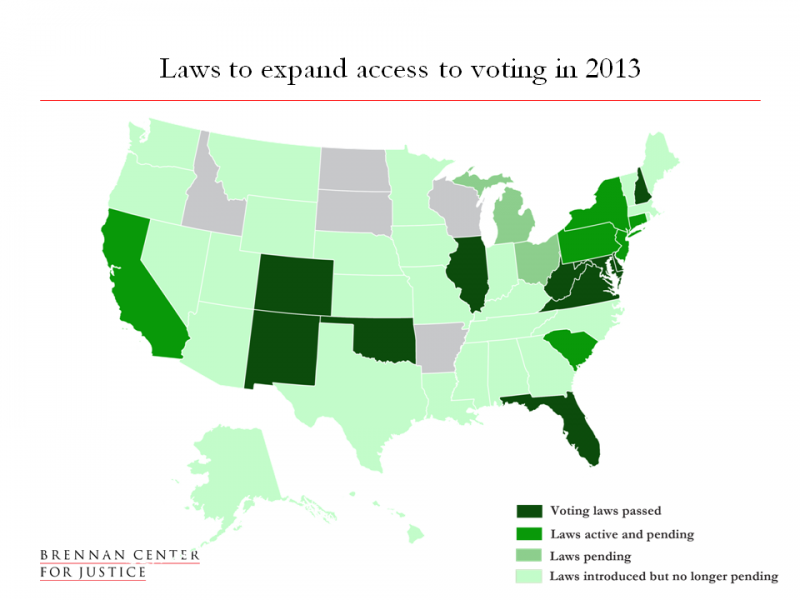
Expanding Access to Voting in 2013

See an enlarged map at: http://www.brennancenter.org/sites/default/files/analysis/images/2013_expansive_map.png
The Brennan Center has been tracking and analyzing the efforts of states to increase registration opportunities, expand early voting, and modernize election systems.

They reviewed the nearly 200 bills to expand voting access that were introduced in 45 states in 2013. Most have failed while a few have passed--like those in New Mexico to automate voter registration at DMV offices, in Oklahoma to make existing photo ID laws less restrictive, and in Virginia to allow online voter registration. 

41 bills in 21 states are currently active, meaning there has been some form of activity, such as a hearing or vote, including:
  • Colorado: Last week the state House passed the Voter Access and Modernized Elections Act, which would allow Election Day registration, create portable registration, and establish a modernized elections commission. 
  • Nevada: A legislative committee passed SB 375, which would digitize voter registration at state agencies, expand online registration, and permit pre-registration by 16 and 17-year-olds. 
  • Florida: The state House voted 118-1 to reinstate the early voting days that had been eliminated before the 2012 election. The bill is currently under consideration in the Senate. 
Perhaps most importantly, the Brennan Center notes that many of these bills are drawing bipartisan support: In Colorado, Democrats in the legislature worked with the mostly-Republican Colorado County Clerks Association to draft a modernization bill; Republicans introduced an online registration bill in Pennsylvania and passed it in Virginia, and; New Mexico's new law received broad bipartisan support and was signed by a Republican governor.

Through these and other election reforms we can help ensure that all eligible Americans can register and cast a ballot. Learn more about expanding access to voting in our next webinar on Voter Registration Modernization on May 16th.

Wednesday, January 30, 2013

2012 Ballot Measures: Elections

November 6, 2012 was the first presidential election since the Citizens United ruling by the Supreme Court in 2010. Consequentially, the 2012 election was more expensive than any other election in our history by more than $700 million.

In an apparent reaction to the ruling, some states voted on limiting or eliminating corporate contributions to elections. Voters in Montana and Colorado approved laws that would prohibit or eliminate corporate contributions and expenditures in both state and national elections. They also sought to charge state lawmakers with asking congressional delegates to overrule Citizens United by amending the U.S. Constitution.

Amendment 2 in Minnesota was an extremely important measure for the future of the state's elections. Amendment 2 would have imposed a strict photo ID requirement at the polls, and although support for the amendment was strong over the summer, it ultimately failed by a few points. This show of support for voters' rights at the polls followed on the heels of Maine voters restoring Election Day Registration in November 2011 after the legislature eliminated it earlier that summer. It seems that given the chance, voters are willing to make changes to election policy and ensure access to the polls.

This post was written by Nonprofit VOTE Intern Lauren Dobbs. Lauren graduated from Boston University with a BA in International Relations in 2011 and will be attending graduate school next fall to obtain an MSc in Development Studies.

Thursday, August 16, 2012

August Webinar: Recruiting Poll Workers

We can't have Election Day without poll workers and translators! Encourage your constituents to serve as poll workers and help your community vote in 2012.

Poll Worker Recruitment for Nonprofits 
Thursday August 30th, 2:00-3:00pm Eastern

Poll workers are on the front lines of helping people vote on Election Day. This year, many states have new ID requirements and voting procedures, so poll worker recruitment and training will be critical to the Election Day experience. Your nonprofit can ensure that poll workers represent and are familiar with your community by encouraging staff, volunteers, and constituents to serve as poll workers. In many areas, translators are also needed to assist non-English speaking voters by translating voting information and answering questions. Learn how your nonprofit can help facilitate democracy in your community by recruiting poll workers, translators, and poll monitors.

Featured Presenter: Jenny Rose Flanagan is the Director of Voting and Elections at Common Cause, where she works with state and national leaders to improve election policy and administration at both the federal and state level. She previously served as the Executive Director of Colorado Common Cause, leading the organization through the successful passage of Colorado's ethics law, and is a primary founder of Just Vote! Colorado Election Protection, Colorado's election monitoring program.

RSVP Now!

Friday, June 1, 2012

Florida Election Law Update

This time last year we reported on a new election law in Florida that drastically restricted third-party voter registration efforts. The 2011 law required that completed registration forms be submitted within 48 hours (groups previously had 10 days) and imposed strict fines for each late registration form. This requirement severely hampered the ability of nonprofits to conduct voter outreach, and even forced the League of Women Voters to halt their registration efforts in the state.

But yesterday, a federal judge granted a preliminary injunction blocking certain provisions of the law. Judge Hinkle blocked the 48-hour return requirement, calling the deadline "harsh and impractical". The injunction also blocked a provision that would open up volunteers to possible felony charges for registering ineligible voters (even if unknowingly). He noted that "If the goal is to discourage voter registration drives and thus also to make it harder for new voters to register, this may work."

The timing of the injunction is important because "when a plaintiff loses an opportunity to register a voter, the opportunity is gone forever." Hopefully this ruling will once again allow Florida's 501(c)(3) nonprofits to safely register their community members ahead of the 2012 election. RSVP for our June 14th webinar for more on nonprofit voter registration.

While much of the law remains intact (including the shortened early voting period), it is not clear yet if the state will appeal. Meanwhile, the Department of Justice is still conducting a separate federal lawsuit challenging the law under the Voting Rights Act.

(Image Source)

Friday, May 4, 2012

Tied Down by Tuesday?

Next week voters in Indiana, North Carolina, and West Virginia will head to the polls to vote on federal and state offices in addition to a number of ballot questions. (Visit Ballotpedia for more on what's on the ballot in every state this year.)

But before Tuesday rolls around, Why Tuesday uses a new infographic to examine the impact of voting on Tuesday.

It suggests that having Election Day on a Tuesday may be stifling U.S. voter turnout, noting that our national turnout rates trail those of countries that have Election Day on either a weekend or designate it as a holiday. It also notes that in every U.S. election since 1996, the number one reason voters gave for not casting a ballot was "too busy/couldn’t get time off to vote" and that in 2010 27% of voters gave this answer.

Increasing turnout probably won't require that we drop Tuesday altogether, but we should be seeking ways to expand access to the ballot through early in-person voting opportunities (including weekends) and simplified vote-by-mail options. Of course there's a role for nonprofits as well: we can help increase turnout by reminding our clients of the upcoming election, answering questions, and offering to help locate their polling place.

If your jurisdiction has an election next week, ask your constituents to think about their plans for voting, or suggest that they take their kids along to see what elections are all about. Whether or not we vote on Tuesday, we can still help ensure everyone has the opportunity to participate!

(Image Source

Tuesday, February 7, 2012

NAACP Reports on "Block the Vote" Efforts

The NAACP recently produced a report, "Defending Democracy: Confronting Modern Barriers to Voting Rights in America," that contextualizes the emergence of recent "block the vote" measures and explains their potential effects.

The report examines a slew of legislative proposals, ballot initiatives, and voting laws that have been enacted or proposed: 14 states have passed 25 measures designed to restrict or limit ballot access, including new and enhanced voter identification requirements, provisions that curtail access to voter registration, limits on registration drives, and reduced voting periods.

Unfortunately, many of these restrictions will disproportionately affect the populations that nonprofits serve, particularly minorities, low-income voters, the elderly, and young people.

But most importantly, the report offers ideas for how to counter these efforts and expand access to our democracy by:
  1. Informing yourself about voting laws and how they affect you.
  2. Equipping your community with the information needed to ensure that all eligible voters are able to successfully cast a ballot.
  3. Practicing “Each One, Bring One” by bringing an eligible first-time voter, or returning voter who otherwise might not vote, with you when you vote on Election Day.
  4. Volunteering to serve as a poll worker, monitor, or translator who assists voters on Election Day.
  5. Taking action to urge your elected officials to fight these restrictive election laws.
Read the report, and join our February webinar "States Move to Restrict Voting: How Nonprofits Can Defend the Right to Vote" to learn more.

(Image Source)