In the Citizens United decision, a 5-4 majority of the Supreme Court decided to treat corporations as persons and grant them so-called “free” speech rights to spend unlimited amounts of money to influence the outcome of elections.
For American democracy the change goes far beyond the newfound capacity for Exxon, Goldman Sachs, Pfizer, AIG or any corporation to pour money into elections. Seizing on a minor campaign case about a movie, the court took aim at the very definition of democracy itself. Democracy at its core means power exercised by people not corporations. People through their representative government passed laws to create corporations in order to conduct commerce or do business, not to sway elections. The people and its government have, or certainly should be expected to have, the right to regulate corporations as deemed necessary.
The actions of five justices go further than any previous governmental action to take the “free” out of free speech. It hands the megaphone and soapbox to those with the greatest access to private wealth. Heretofore corporations were strictly limited on their ability to spend money in elections. Now the democratic principle of one person, one vote gets ever more replaced by pay to play.
Large flows of special interest money from corporate executives, PACs, lawyers, and lobbyists are already flooding elections. Individuals tied to banks, insurance companies, drug companies and others industries and interests invested more than a billion dollars in large election donations in 2008 alone. Instead of swinging the door open wider to include corporate treasuries, the courts and Congress should, to save democracy, be exploring ways to limit or end the undue influence of all big money out of elections.
Larger flows of money for or against candidates can only spawn higher levels of cynicism by the public with more reason to believe their democracy and their elections are controlled by large monied interests. Big money, as courts have noted before, is corrupting in appearance and actuality. In the end, there is no difference between large money transactions to candidate campaigns called campaign donations or independent expenditures any bribe or payment to a candidate to gain access, influence and win an outcome – be it their election or defeat or derailing a proposed policy or enacting a new one.
Every advanced democracy has sought and continues to find reasonable ways to regulate the flow of money in campaigns and creation of public policy. As they should. Cast aside by this court is the compelling public interest government has in creating a level playing field for competitive elections and balancing in the ability of the wealthy versus the common citizen to determine public policy outcomes. Democracy requires fair elections and equitable public deliberation or there’s another name – plutocracy.
What next? It’s a bad decision but so polar to the principle of democracy that it can’t last in this form. Short run fixes are being called for and may help. But there are only two solutions. Public election funding and free media used in all modern democracies to take big money out of elections and to discourage or eliminate the unlimited independent expenditures the court now sanctions. Systems that combine public campaign funding with incentives for the greater participation of small donors allowing ordinary candidates to mount campaigns and get their message out on a level playing field.
The other solution is for the evolution of a Supreme Court that gets democracy and the corrupting role of money. It is a Court looking forward not back that restores the rights of citizens over corporations and the meaning of “free” in free speech. In the 19th century the courts endorsed racial segregation and even slavery. Today courts have endorsed “free” speech rights to those who can pay the highest price. These things can change and, in the resilience of American democracy, they will.

Sunday, January 31, 2010


Thursday, January 28, 2010
Citizens United vs. FEC
 Hillary: The Movie, a film by Citizens United and the basis for the challenge to restrictions on corporate spending in Citizens United vs. FEC
Although the main conversations on the Citizens United vs. Federal Elections Commission Supreme Court decision have been about the impact on and by for-profit corporations, there are implications for nonprofit organizations as well.
The opinion, issued on January 21st and decided in a 5-4 split, supports the constitutionality of corporations making independent expenditures from their general treasury for electioneering communications (previously these expenditures had to be made through voluntary donations via a Political Action Committee).
Justice Stevens gave the dissenting opinion, quoted in part here:Alliance for Justice offers some simplified bullet points for understanding the impact of Citizens United on nonprofit organizations, along with some key questions (will this ruling apply to labor unions?) . It also offers the following advice:
"In the context of election to public office, the distinction between corporate and human speakers is significant. Although they make enormous contributions to our society, corporations are not actually members of it. They cannot vote or run for office. Because they may be managed and controlled by nonresidents, their interests may conflict in fundamental respects with the interests of eligible voters. The financial resources, legal structure,and instrumental orientation of corporations raise legitimate concerns about their role in the electoral process. Our lawmakers have a compelling constitutional basis, if not also a democratic duty, to take measures designed to guard against the potentially deleterious effects of corporate spending in local and national races."
"While much of the focus has been about increased spending by for-profit corporations, it is important to remember that these changes apply to issue-based organizations that promote the social good. More than ever, nonprofit corporations can and should actively participate in elections. Even if you think the case was wrongly decided, 501(c)(4)s and other nonprofit corporations (except for 501(c)(3)s) should take advantage of it--use it to strengthen democracy by increasing your public communications about the candidates and what’s best for the future of our country."Finally, in a recent phone briefing, the Alliance for Justice reminded the nonprofit community:
"501(c)(3)s remain subject to the absolute prohibition on intervening in an election campaign on behalf of or opposition to a candidate for public office. Therefore, little will change for public charities and private foundations as a result of this opinion."
Thursday, January 21, 2010
Attitudes towards the Census
 A national survey by the Pew Research Center for the People & the Press was conducted Jan. 6-10 on public knowledge and attitudes towards the 2010 Census.
Among the results were:
- Nine-in-ten Americans describe the census as either very (60%) or somewhat (30%) important for the country, and about eight-in-ten say they will either definitely (58%) or probably (23%) participate.
- Unfamiliarity with the census is most widespread among younger adults and Hispanic Americans.
- 64% are aware that the census is used to decide how many representatives each state will have in Congress.
- 59% are aware that the census is used to decide how much money communities will get from the government.
- 11% incorrectly believe that it the census is used to locate illegal immigrants so they can be arrested.
- Only 31% of Americans are aware that participation in the census is required by law.
To read more, click here.
Wednesday, January 20, 2010
Rhode Island Assembly overrides veto of teen registration bill
 From the Brookings Institute-
After three consecutive years' of governor vetoes, the Rhode Island assembly succeeded in enacting into law a teen voter pre-registration bill. It joins Hawaii and Florida, as well as Puerto Rico, in permitting pre-registration for teenagers. Click here to read the press release.
Thursday, January 14, 2010
Racist terms or not, fill out that form.

There has been some hubbub lately about the inclusion of a certain racial term on the 2010 U.S. Census form.
Question number 9 on the form will ask: "What is Person 1's race?" You will be asked to mark an answer box. The choices are
White;
Black, African-American, or Negro;
American Indian or Alaska Native;
Asian Indian
etc., etc.
Here are the 3 best explanations I've heard in response to outcries that people should refuse to participate in a Census is that includes such a seemingly outdated, racially loaded (if not outright racist) term.
Why is the term "Negro" included alongside "Black" and "African-American" on the 2010 Census form?
The 2010 Census questions underwent strenuous focus groups test; no question is on the form by accident, habit or tradition. During testing, it was found that many older, black Americans (particularly in southern parts of the US) still identify along this term. Census officials report that many wrote in "Negro" on their 2000 Census form (CBS News). The term is included in an effort to encompass the variety of racial categories with which black people in America currently identify.
Why is boycotting the Census based on the inclusion of this term a bad idea?
As Bridgette Rongitsch, NVEN National Director, puts it: refusing to fill out a Census form on this basis "is only a win" for those groups and individuals who want to deny resources and funding to black communities, and only a lose for these black communities. Period. Each person on each completed form is worth about $1200 a year to local communities - at the end of the day, this is what matters most.
What if I still feel the Census Bureau's use of this term is wrong?
If individuals want to protest the inclusion of this term on the form, a good way to convey disapproval in a proactive way would be to include a note with their completed Census questionnaire when they mail it back.
Tuesday, January 12, 2010
IMPORTANT - QACs still needed!!!
 It's an easy, free, and effective way to directly help your local communities - volunteer your space as a Questionnaire Assistance Center for the 2010 Census.
***Learn how to become a QAC by contacting your local or regional census operations partnership specialist- click on your state for local contact information.***
Why does the Census Bureau need your organization's help?
Questionnaire Assistance Centers will be a crucial part of Census operations this year. For those who are having difficulties in understanding or filling out their Census forms, having personal, confidential assistance available in convenient locales -i.e., Questionnaire Assistance Centers- helps those individuals get their families are counted, so that that their communities can receive needed resources and funding.
***Learn how to become a QAC by contacting your local or regional census operations partnership specialist- click on your state for local contact information.***
What does it mean to become a Questionnaire Assistance Center? Signing on to become a QAC entails donating a small area of space in your facility for 15 hours per week (3 hours during the day or the evening, 5 days a week) during parts of March and April to Census employees. These employees will set up and staff 1 table and 2 chairs to help people who are having difficulties in filling out their Census forms.
***Learn how to become a QAC by contacting your local or regional census operations partnership specialist- click on your state for local contact information.***
What does the agreement form mean?
The form outlines the donation agreement, along with some legal language aimed at protecting the nonprofit donor from liabilities. "The form is not even absolutely necessary," says one Regional Census Office representative. "Organizations can donate space without going through the formalities of a signed agreement simply by contacting their local or regional partnership specialist and indicating their interest in assisting."
***Download the QAC agreement form.***
***Learn how to become a QAC by contacting your local or regional census operations partnership specialist- click on your state for local contact information.***
____________________________________________________________
The Boston Regional Census Office is still confirmed as still signing on organizations in Massachusetts, New Hampshire, Maine, Vermont, Rhode Island, Connecticut and New York. For more information on becoming a QAC in this area, contact Norman Eng by email at
norman.eng@census.gov or by phone at (617) 223-3701.
Other Regional Offices may still be recruiting as well - to find out, contact your local or regional Census partnership specialist. Find your contact info by clicking on your state here.
Thursday, January 7, 2010
Court rules against Washington's ban on felon voting
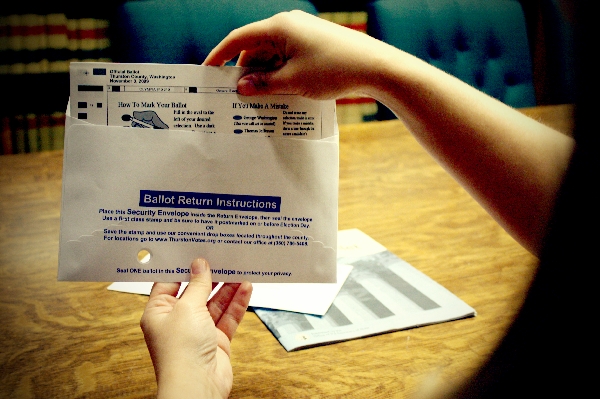 (WA SOS blog, NY Times)
The 9th Circuit Court of Appeals has thrown out Washington’s longstanding ban on voting by felons.
The surprise 2-1 ruling comes in a case brought in U.S. District Court in Eastern Washington almost 14 years ago by Muhammad Shabazz Farrakhan and three other black inmates, and by a Native American and a Latino inmate. The inmates said minorities are disproportionately prosecuted and sentenced to prison, and that their automatic disenfranchisement violates the federal Voting Rights Act.
The ruling means the more than 18,000 felons behind bars in the state could get back their right to vote -- without having to wait until they are released from prison and are no longer on probation or parole. The ruling also could open the door to similar lawsuits in the 9th Circuit's eight other states and two territories.In recent years, only two states - Maine and Vermont - have allowed inmates the right to vote.
Tuesday, January 5, 2010
Coming to a city near you- the Portrait of America Tour!
 Across the country, the new year has marked the kickoff of the Census Bureau's coordinated nationwide and regional "Portrait of America" van tours, designed to help inform people in undercounted communities about the importance of filling out their 2010 Census form.
Participants will share images and stories, explaining why the census will make a difference to their communities.
To learn about the national "Portrait of America" tour, click here.
To find out about your region's "Portrait of America" tour, contact your local or regional partnership specialist (find contact information here).
Tuesday, December 29, 2009
For auld lang syne
 New Years Eve is a mere 48 hours away.
With it comes January 1st, 2010, upon which many new laws across our great nation will take effect. Here's a look at a few of the new laws, passed by your elected legislators, that will become effective this New Years Day.
1. New Hampshire will prohibit the trafficking of people for the purposes of sexual or labor exploitation, providing for forfeiture, restitution and compensation.
2. In Montana, insurance companies will be required to provide coverage for autism spectrum disorders.
3. In Texas, teenagers who might want a tan for prom now will have to be accompanied to the tanning facility by an adult.
4. Same-sex couples will be able to marry in New Hampshire.
5. Any lighter that appeals to children will no longer be allowed to be sold in Louisiana. This includes lighters that have a toy-like appearance or entertaining audio or is commonly recognized as appealing, attractive, or intended for use by young children.
6. Illinois joins at least 18 other states in prohibiting drivers from sending text messages while driving.
7. In Texas, college students will need to show proof they've been vaccinated against bacterial meningitis before they can live on campus.
8. In Kentucky, people will be limited on how much money they can borrow through payday loans.
9. Smoke detectors in Texas now will need to be capable of alerting a hearing-impaired person if requested by a tenant.
10. Oregon’s new seat belt law requires children under the age of 16 to wear a seat belt on an all-terrain vehicle or a motor vehicle while on public property.
To read about more new state laws taking effect January 1st, 2010, click here.
Monday, December 28, 2009
Nonprofit Tagline Report
 Vamping up your nonprofits' 2010 Census campaign, voter outreach campaign, or simply reevaluating your communications strategies?
Check out Nancy Schwartz's Nonprofit Tagline Report on building the brand name of your nonprofit initiative. Sections include:
- The 10 Have-Tos for Successful Taglines.
- 7 Examples of what not to do.
- What Makes a Winning Tagline.
- Over 2,500 Nonprofit Tagline Examples.
Check out her top 3 "Dont's" for nonprofit taglines!
1. Don’t be generic. Be specific and as emotive as possible to highlight a connection
between an individual and your organization.
2. Don’t craft a tagline your organization can’t stand behind 100%. Your
nonprofit has to be able to deliver what you promise. When you do so, your
organization reaffirms its credibility. When you don’t, you lose any you may have.
3. Don’t veer off focus.
Monday, December 21, 2009
Counting prisoners in the wrong place?
African-American leaders weigh in on the impact of counting prisoners, ineligible to vote in 48 states, in prisons versus their home communities. Why count people in far away communities where they cannot vote nor derive any benefit from local services?
Thursday, December 17, 2009
Children and the Census
 Photo c/o US Census Bureau PIO
Children are the most often missed age group in the Census, according to Why are Young Children So Often Missed in the Census, a new report by Dr. William P. O’Hare of the The Annie E.Casey Foundation. In the 2000 Census, the net undercount of children under 10 years old was 1 million; children under 5 account for over three quarters of this. The report notes a more pronounced discrepancy in rates of undercounted minority children. In 2000, black males under age 5 were missed at a rate of 5.3 percent, compared to 3.3 percent for non-black males in this age group. Among females, blacks under age 5 were missed at a rate of 5.4 percent, compared to 3.8 percent for non-blacks in this age group.
There are several factors that explain the high undercount of young children: Young children are more likely to live in households with 7+ occupants, which make it difficult to complete the census form with spaces for only six names; children are also more likely to live in places characterized as hard to count, including rental units, mobile homes, and complex households with adults other than parents. Looking ahead to the 2010 census, prospects for an accurate count of children do not look promising, as there has been an increase in the proportion of young children from minority populations from previous years, there are more children living with undocumented residents than in previous years, and an estimated two million children will be affected by the housing crisis which will add to the complexity of getting an accurate count.
The report offers several suggestions for combating the undercount of children, including reaching out to different nonprofit agencies and doctors whose clients are families with young children to raise awareness of the census.
Click here to read the full report.
Wednesday, December 16, 2009
MOVE Act and 2010 primary dates
 (Image - Senatus)
The new Military and Overseas Voter Empowerment (MOVE) Act, which stipulates a 45-day deadline for states to send general election ballots to military and overseas voters, has many states scrambling to either push back their 2010 primary date or receive a compliance waiver in order to avoid violating the Act.
States are citing many factors, such as the purchase of new equipment, new election administration processes and voting systems, as preventing them complying with the MOVE Act. The Act was passed after the 2008 elections, when it was found that up to 1 in 4 military and overseas voters were disenfranchised because they didn't receive their ballots in time.
Read more from the Pew Center.
Monday, December 14, 2009
2010 Census On Track
 In a news briefing earlier this morning, Census Director Robert Groves reported that preparations for the 2010 Census are nearly complete, and it’s on track to being a successful count. According to Groves, the bureau has recently completed compiling its master address list used to mail out the census forms. In spite of the challenges facing the census count including undocumented residents wary of census takers and the high number of foreclosures, Groves is hopeful that the 2010 Census will have a strong turnout, owing in part to the short form and the outreach efforts emphasizing the confidentiality of the process. ''The plan has been set. Operations have been assembled,'' Groves said. ''It is a time for all of us, especially social, political and religious leaders around the country to get the word out that everyone needs to participate -- that it is easy to do, and it's especially safe.''
Read more about the press briefing here.
Thursday, December 10, 2009
The Fair Elections Now Act

Legislation that would reform public financing of congressional elections was recently introduced in the House and Senate. The legislation, sponsored by Senator Durbin (D- Ill) and Representative Larson (D- Conn) and has 5 senate co-sponsors and 119 house co-sponsors, includes a voluntary public financing system that would be driven by small-donors. "We believe the answer is grassroots involvement," Larson said. "President Barack Obama demonstrated that it could be done."
The legislation is in part a response to a case before the Supreme Court which would allow unlimited corporate expenditures during elections. "It takes a major scandal to create a major reform," Durbin said. "I don't know that we've reached the level in the Senate or in the nation where people are going to demand this of us.... But if they think that the Supreme Court has tipped the scales so dramatically that they don't have a fighting chance any more, they may be open to this."
Under this legislation, funds would be allocated equally to House candidates and based on population of the states in Senate elections. According to Sen. Durbin, the legislation would allow candidates to focus on the issues instead of spending "every waking moment begging for money."
To read more about this, click here or here.
Wednesday, December 9, 2009
Civic engagement of non-college-bound youth
 The 2008 election showed marked increases in the under-30 age group - the only age group to show such increases - continuing an upward trend that began in 1996.
However, to what extent is this a movement that can be characterized across American youth as a whole? PACE has released a white paper that explores the divide between low and high income youth civic engagement, citing an imbalanced distribution of educational, political, and/or civic resources and opportunities that encourage voting.
Key data points include:
- Nearly 60 percent of 18-24 year-old college students voted in the 2004 presidential election, while only one-third of non-college attending youth (ages 18-24) voted.
- During the 2008 primaries, college students were nearly four times more likely to have voted than students not attending college (25 percent vs. 7 percent).
- During the 2008 presidential election, 70 percent of all young voters in the 2008 election had gone to college, although just 57 percent of U.S. citizens under 30 have ever attended college.
Saturday, December 5, 2009
Bias Older, Higher Income Voters - It's In the Mail

Vote by Mail is growing. It's convenient for some. It costs less. But is it good for democracy? Or is it newest form voter disenfranchisement plan - overrepresenting the votes of older wealthier voters and underrepresenting younger and lower income voters. The same bias found in registration laws, felon disenfranchisement, vote suppression strategies and the like.
A new survey looks at the demographics of those using making the greatest use of vote by mail in California elections. The Field Poll found those permanently registered to receive mail ballots and most likely to participate in mail elections where much older and whiter vs younger and hispanic. This skew can also be found in states like Oregon with who distribute mail ballots automatically to all registered voters, but more so in a state like California where automatically getting mail ballots is optional.
What if the US Census were only conducted by mail? The population profile would look like it did 20 years ago, perhaps even older and wealthier. Fortunately the Census goes to great lengths to include everyone setting up questionnaire assistance and be counted centers across hard to count areas and conducting an extensive canvass of non-respondents.
Early voting facilitates participation and can save costs. But like the Census, democracy means elections that provide a range of opportunities for people of all backgrounds to vote - by mail, early in person and at a poll location or drop box on Election Day. The trend towards all mail balloting - without options - could set voting rights advances back a few decades or more.
Wednesday, December 2, 2009
From Project Vote: Representational Bias in the 2008 Election
 Doug Hess and Jody Herman of Project Vote have just released this report detailing the increase in diversity in the 2008 electorate.
The report finds that although older, wealthier White voters continue to make up a disproportionately larger amount of the electorate, a rapid increase in the diversification of the adult citizen population since the 2004 election contributed to increased voting among minority groups in 2008.
Among the report's conclusions are:
- Voting among non-Whites in 2008 made up approximately 91 percent of the increase in the total number of voters since 2004. This increase was driven by an increase in minority voters under the age of 30. In fact, because of this increase in participation by young minority voters, 2008 was the only election in recent memory where the voting rate by youth increased while the rate for those 30 and over did not.
- Registration rates increased remarkably among young Black men (8 percentage points), young Latinos of both genders (6 percentage points), and Asians (5 percentage points for young men and 13 points for young women).
- Among younger populations, Black women voted at the highest rate (64 percent), followed by White women (56 percent) and Black men (52 percent). All minority groups under 30 saw increases in their turnout rates compared to 2004.
Monday, November 30, 2009
Regional Census Offices search for Questionnaire Assistance Centers
 Boston-region organizations - Do you serve populations that speak a language other than English? Are you willing to donate space for at least 15 hours a week that can be used by census employees to provide language assistance for people completing 2010 Census forms?
If so, your Census Office wants to hear from you. The Census Bureau is currently identifying facilities that can be used as Questionnaire Assistance Centers (QAC). The Bureau needs 2,460 sites in the Boston Region alone. Questionnaire Assistance Centers simply require a small private place in a public facility where the Census Bureau can staff a table with translators to provide in-language assistance to help non-English speakers complete the 2010 questionnaire. Questionnaire Assistance Center will be open between mid-March and mid-April 2010.
If you are a Boston-region organization and would like to serve as a QAC, please contact your partnership specialist or the Boston Regional Census Office at (617) 424-4501 or by email at boston.regional.office(at)census.gov by December 21.
Don't live in or around Boston? Census Regional Offices across the country are looking for facilities to serve as Questionnaire Assistance Centers. To contact your Regional Census Office about becoming a Questionnaire Assistance Center, click on your state.
Wednesday, November 25, 2009
Census jobs opening across country
 Got this press release from Kara Mapel at the Kansas City Regional Census Office. Seems they have officially started hiring for the spring 2010 count and have thousands of positions to fill in 30 local census offices in Minnesota, Iowa, Kansas, Missouri, Oklahoma and Arkansas.
Similar staffing needs are occuring at Regional and Local Census Offices around the country - keep your ears open. Those interested in applying for these jobs can call the Toll Free Jobs Line at 1‐866‐861‐2010 for more information.
Subscribe to:
Posts (Atom)