Showing posts with label Virginia. Show all posts

Friday, November 22, 2013

CIRCLE Reports on Youth Turnout in NJ and VA

According to CIRCLE's calculations of exit polls, youth turnout was 26% in Virginia and 18% in New Jersey this year.  Using the same methods, CIRCLE concluded that youth turnout in Virginia was 17% in 2009 and 18% in 1997, and in New Jersey 26% in 1997 and 19% in 2009. This suggests a significant increase in Virginia in 2013 compared to the two most recent gubernatorial races.


These turnout estimates mean that roughly 288,000 young voters cast ballots on November 5th in Virginia, out of the estimated 1.1 million 18-29 year-old citizens who live in that state. In New Jersey, roughly 206,000 young voters cast a ballot out of the estimated 1.2 million 18-29 year old citizens.

CIRCLE Director Peter Levine noted that "Although 18% and 26% are far from satisfactory, these statistics should be put in context," and that "Turnout is always much lower in off-year gubernatorial elections than in presidential years"

Read CIRCLE's full analysis.

* The estimated numbers of young people who voted in the 1997 and 2009 governors’ races were calculated using: (1) the number of ballots cast in each race according to the media, (2) the youth share of those who voted, based on the exit polls conducted by Edison Research for the National Election Pool, and (3) the estimated number of 18-29 year old citizens taken from the Census Current Population Survey, March Demographic File of that year. Edison Research estimates that its exit polls have a margin of error rate of plus or minus three percentage points.

Tuesday, June 18, 2013

States Are Improving Elections in 2013

This year has seen a number of new laws that will improve ballot access and streamline the election process for both voters and elections officials.
Colorado recently passed the Voter Access and Modernized Elections Act that includes provisions for Election Day Registration and portable registration, in addition to creating a bipartisan task force to study voting changes and consider future reforms.
Last month, Florida Governor Rick Scott signed HB 7013 into law which will take effect January 1, 2014. The new law increases the number of early voting days and hours allowed, expands the types of sites that can be used as early voting locations, allows new residents to change their addresses at the polls, and gives absentee voters who forgot to sign their ballot the opportunity to correct the mistake.
In addition to expanding early voting, Maryland will allow same-day registration during the early voting period beginning in 2016. Both Virginia and West Virginia have passed online voter registration, bringing the number of states that have passed or implemented online registration to nineteen.

Friday, April 26, 2013

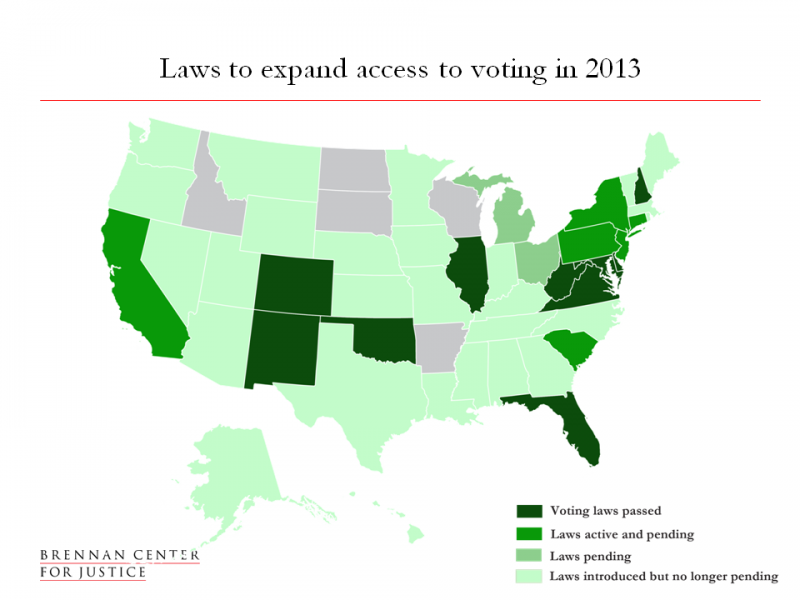
Expanding Access to Voting in 2013

See an enlarged map at: http://www.brennancenter.org/sites/default/files/analysis/images/2013_expansive_map.png
The Brennan Center has been tracking and analyzing the efforts of states to increase registration opportunities, expand early voting, and modernize election systems.

They reviewed the nearly 200 bills to expand voting access that were introduced in 45 states in 2013. Most have failed while a few have passed--like those in New Mexico to automate voter registration at DMV offices, in Oklahoma to make existing photo ID laws less restrictive, and in Virginia to allow online voter registration. 

41 bills in 21 states are currently active, meaning there has been some form of activity, such as a hearing or vote, including:
  • Colorado: Last week the state House passed the Voter Access and Modernized Elections Act, which would allow Election Day registration, create portable registration, and establish a modernized elections commission. 
  • Nevada: A legislative committee passed SB 375, which would digitize voter registration at state agencies, expand online registration, and permit pre-registration by 16 and 17-year-olds. 
  • Florida: The state House voted 118-1 to reinstate the early voting days that had been eliminated before the 2012 election. The bill is currently under consideration in the Senate. 
Perhaps most importantly, the Brennan Center notes that many of these bills are drawing bipartisan support: In Colorado, Democrats in the legislature worked with the mostly-Republican Colorado County Clerks Association to draft a modernization bill; Republicans introduced an online registration bill in Pennsylvania and passed it in Virginia, and; New Mexico's new law received broad bipartisan support and was signed by a Republican governor.

Through these and other election reforms we can help ensure that all eligible Americans can register and cast a ballot. Learn more about expanding access to voting in our next webinar on Voter Registration Modernization on May 16th.

Tuesday, February 8, 2011

The Census Releases New Data

...and it doesn't bring good news for New Orleans. Last week, the Census Bureau released new data showing that New Orleans experienced a population loss of 140,845 residents--a drop of 29% from 2000. In addition to losing New Orleans city residents, Louisiana also lost a congressional seat (down to six from seven).

Because of the exodus in the wake of Hurricane Katrina, the percentage of black population fell to 60.2% from 67.3%. Jacques Morial, a community organizer, thinks that "The city is more affluent, more Latin and a little whiter than it was before Katrina." Many poor residents have stayed away because fewer than a quarter of the city's 4,200 public housing units demolished by the storm have been rebuilt. "The people who've had the hardest time getting back to New Orleans are those who had the fewest resources," said Tom Piazza, author and city resident.

In addition to Louisiana, the Census Bureau also released data for Mississippi, New Jersey, and Virginia because their election cycles are among the earliest. Check out the latest Census widget below for more details.


(Image Source)

Share

Wednesday, December 8, 2010

Students Draw the Lines in Virginia

The 2011 Virginia College and University Legislative Redistricting Competition was recently announced, and will allow students to take a stab at redistricting their state. After Census data is made available, student teams will draw Virginia’s congressional and state legislative districts using software developed by the Public Mapping Project. (See our earlier post for more on this tool.)

Their redistricting plans will be judged on whether or not the districts are: compact; contiguous; equal in population; in compliance with the federal Voting Rights Act; encompass communities of interest, and; respect existing political subdivisions. In addition to educating students and the public about the redistricting process, sponsors also point out that the maps will "demonstrate alternative ways to draw Virginia’s districts, which may be compared favorably or unfavorably to the maps produced by the state government."

And for the less studious, or those just looking to express themselves, the Sunlight Foundation has developed "Better Draw a District", which allows you to draw over districts and "encourages you to add graffiti to any and all congressional districts." (Note, this is a self-described "crude, far-from-serious, yet very fun" project.)

Both of these projects make it clear that this redistricting season will have something for everyone.

(Image Source)


Share